
Imagine the hypothetical scenario in which you are forced to choose one food to eat for the rest of your life, with the choices being between a Twix candy bar or Coffee Crisp. This may seem like a small, simple choice, but this is the only thing you will be allowed to eat for the rest of your life, so you have to put some thought into this decision. This decision will be based on memories you have associated with each option, whether you enjoyed the taste of Twix, or Coffee Crisp made you throw up one time when you were younger.
The underlying processes in decision making are fundamentally the same in all types of decisions, from simple choices like choosing to study at Stauffer Library or Douglas Library for the day, to life changing decisions such as the example of the chocolate bars. The brain is presented with a decision, so it will retrieve past memories to base it off of. If for example, you have been very productive at Douglas Library, rather than at Stauffer, then your prefrontal cortex will make this distinction and choose to spend the rest of the day at Douglas.
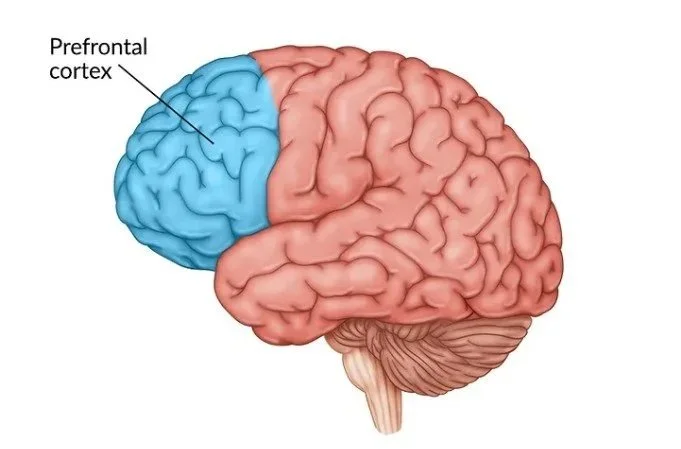
Prefrontal Cortex (blue) relative to the rest of the brain. Source: Maher, Courtney. “Prefrontal Cortex Damage: What to Expect & How to Recover.” Flint Rehab, 18 Aug. 2020, www.flintrehab.com/prefrontal-cortex-damage/.
The prefrontal cortex is the main structure involved in these processes, with its primary function to store and retrieve short term memories, although it works closely with the hippocampus to use these memories.
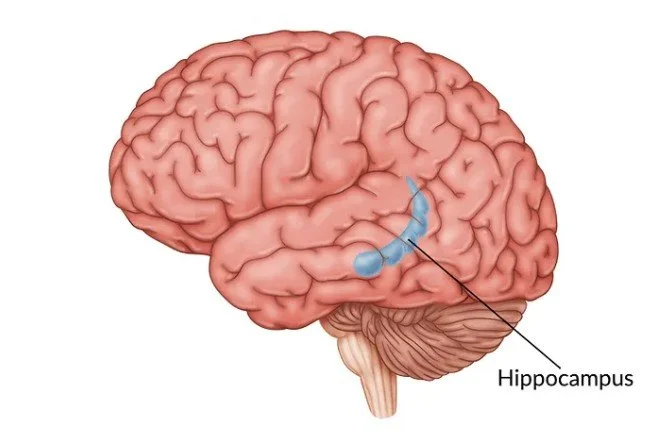
Hippocampus (blue) relative to the rest of the brain. Source: Rehab, Flint . “Hippocampus Damage: Effects, Treatment & Recovery.” Flint Rehab, 1 Apr. 2020, www.flintrehab.com/hippocampus-brain-injury/.
There are many other regions in the brain involved during thought processes, although the identification of the exact functions remains a large gap in neurophysiology.
These processes occur in four main steps, where we start with an initial sensory stimuli that transmits a signal to the brain via sensory neurons. Sensory neurons receive information from the outside world and convert it into action potentials for the brain to interpret. Going back to the chocolate bar example, when you are told that you must choose between both chocolate bars, sensory neurons take in this information and process it to the brain. A second stimulus further excites the hippocampal neurons, causing an initial neural response from the collection of both stimuli, which goes on to activate the prefrontal cortex. This stimulus comes from other information necessary to make the decision. So if it is a person telling you you have to choose between Twix and Coffee Crisp, these secondary stimuli will take in the speaker’s tone, body language and use of words to evaluate the situation. The PFC then retrieves relevant past information to make the decision and relate them to the situation. If you had an allergic reaction last time you had a Coffee Crisp, then this memory will get brought into the equation. In the final step, the PFC commits to the necessary course of action for the decision made. This is mediated by motor neurons that send the signal from the brain to the muscles, to pursue the intended path. Finally, after much thought, your brain chooses Twix over Coffee Crisp, because as we all know, Twix is much better than Coffee Crisp, hence the motor neurons will send signals to your muscles, to indicate that you chose Twix.
You might be asking yourself, well how fast does this process take place, how much time does it take for us to receive a signal and carry through our chosen course of action? When we are driving for example, we need these decisions to be made fairly quickly, or else we would all end up in the hospital. Benjamin Libet, a prominent neuroscientist in human consciousness research, studied the timing as to when do we actually make the decisions and carry out their respective actions. He claims that the decisions we make are predetermined, which means that our brain has already made the decision before we become consciously aware of the decision we make. Benjamin Libet’s contributions to decision making processes can be adapted to the philosophical debate on free will. He showed scientific evidence supporting determinism, but there is much controversy in the accuracy of the data. So if our biology knows our every move, does it disprove free will? But this is a topic for another time…
Feel free to write back if you have any comments, questions, concerns or any ideas as to what you want us to write about.
Jaiden Plante